Meta Description
Explore the top 5 marketing automation platforms in 2026, including HubSpot, Mailchimp, ActiveCampaign, Salesforce Marketing Cloud, Brevo, and GoHighLevel. A complete guide for businesses, startups, and agencies.
Why Marketing Automation Has Become a Business Necessity?
Most businesses today don’t fail because they don’t get attention. They fail because they don’t follow up at the right time. Think about this situation.
A visitor lands on your website, downloads a free guide, or clicks on your ad. They show interest, but after that, nothing happens. No email. No reminder. No follow-up. That small delay often means a lost customer.
Research from industry studies shows that businesses using marketing automation generate up to 451% more qualified leads compared to those that rely on manual marketing processes. This is not a small improvement it is a complete shift in how modern marketing works.
This is where marketing automation platforms come in. They help businesses automate emails, manage leads, track customer behavior, and build personalized customer journeys without manual effort.
In this guide, we will explore the top 5 marketing automation platforms in 2026, how they work, their strengths and weaknesses, and which one fits your business type.
What is a Marketing Automation Platform?
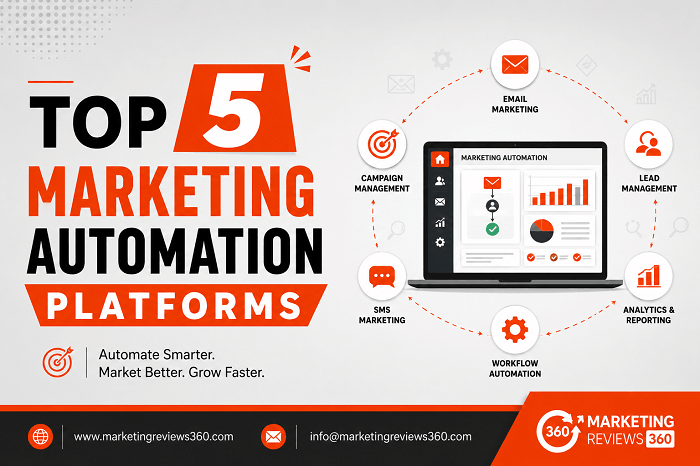
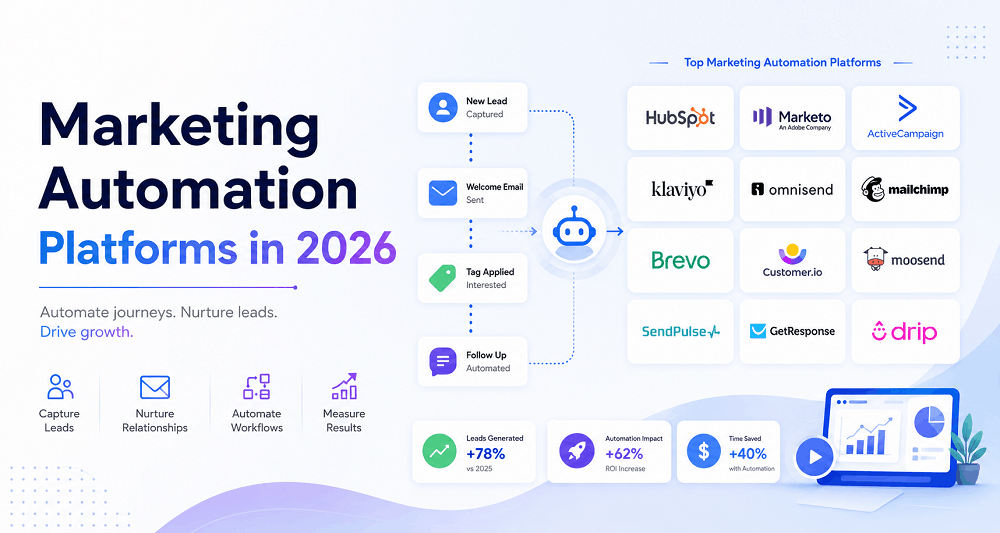
A marketing automation platform is software that helps businesses automate repetitive marketing tasks and manage customer communication across multiple channels. Instead of manually sending emails or tracking leads, the system does it automatically. A typical marketing automation system helps with:
- Email marketing campaigns
- Lead nurturing workflows
- Customer segmentation
- Behavioral tracking
- SMS and multi-channel messaging
- Sales funnel automation
- Performance analytics
In simple terms, it works like a digital marketing assistant that runs campaigns 24/7 without stopping.
Modern platforms also connect with CRM systems, making it easier to align marketing and sales.
Why Businesses Need Marketing Automation Today?
The digital market has become too fast for manual processes. Here are a few reasons why automation is now essential:
- Customers expect instant responses
- Businesses handle thousands of leads daily
- Personalized marketing increases conversion rates
- Manual follow-ups lead to missed opportunities
- Competition is increasing across all industries
Studies show that automated email campaigns can increase conversion rates by up to 50% higher than manual campaigns.
Because of this, businesses are actively searching for the best tools that offer both automation and scalability.
What to Look for in a Marketing Automation Platform?
Before choosing a platform, it is important to understand what makes a tool effective. Key evaluation factors include:
1. Ease of Use
A good platform should be easy to set up and manage without technical skills.
2. Automation Capabilities
Look for workflows, triggers, and behavior-based automation.
3. CRM Integration
Marketing becomes more powerful when connected with customer data.
4. Multi-Channel Marketing
The tool should support email, SMS, social, and ads.
5. Analytics and Reporting
You should be able to track open rates, conversions, and customer journeys.
6. Pricing and Scalability
It should match your budget and grow with your business.
These criteria help businesses make a proper marketing automation software comparison before selecting a platform.
1. HubSpot Marketing Hub
HubSpot is one of the most widely used marketing automation platforms in the world. It is popular because it combines CRM, email marketing, and automation in one system.
Key Features:
- Unlimited email sending accounts
- Inbox rotation system
- Built-in warm-up tool
- AI campaign optimization
Strengths:
- Great for large-scale outreach
- Strong deliverability system
- Simple interface
Weaknesses:
- Limited CRM features
- Not ideal for complex sales pipelines
HubSpot is often recommended for businesses that want a simple but powerful marketing automation system without technical complexity. It is widely used by startups and small businesses due to its clean interface and beginner-friendly design.
However, while HubSpot is easy to use, many businesses need proper onboarding to take full advantage of its automation, CRM, and reporting features. The platform offers significant flexibility, but the best results come when workflows, lead management, and customer journeys are set up correctly from the start. Once optimized, HubSpot can become a powerful engine for generating and nurturing leads.
If you’re comparing marketing automation platforms and want honest reviews, insights, and feature breakdowns, MarketingReviews360 is a useful resource. It helps businesses understand the strengths, limitations, and pricing of different tools so they can make more informed decisions before investing.
Read the HubSpot review.
2. Mailchimp
Mailchimp started as an email marketing tool but has evolved into a full marketing automation platform. It is especially popular among small businesses and content creators.
Key Features:
- Email campaign automation
- Audience segmentation tools
- Pre-built email templates
- Basic CRM features
- Reporting dashboards
- Simple automation workflows
Strengths:
- Very beginner-friendly
- Strong email marketing capabilities
- Free plan available
- Easy drag-and-drop builder
Weaknesses:
- Limited advanced automation features
- Not ideal for complex marketing funnels
Mailchimp is best for businesses that focus mainly on email marketing rather than full-scale automation systems.
It is a strong entry-level option for companies starting their digital marketing journey.
However, while Mailchimp is easy to learn and use, businesses with growing marketing needs may eventually require more advanced automation and customer journey capabilities. For email marketing, newsletters, and audience engagement, it remains one of the most accessible platforms available. When used strategically, Mailchimp can help businesses build stronger customer relationships and improve campaign performance over time.
If you’re exploring email marketing or marketing automation platforms, it is important to compare features, pricing, and scalability before making a decision. MarketingReviews360 provides in-depth reviews, comparisons, and practical insights to help businesses find the right solution for their goals, budgets, and long-term growth plans.
Read Mailchimp review.
3. ActiveCampaign
ActiveCampaign is known for its advanced automation and deep personalization features. It focuses heavily on customer journey automation rather than just email marketing.
Key Features:
- Advanced workflow automation
- Behavioral tracking
- CRM and sales automation
- Email personalization tools
- SMS automation (on higher plans)
- Lead scoring and segmentation
Strengths:
- Very powerful automation engine
- Excellent for customer journey mapping
- Highly flexible workflows
- Strong personalization features
Weaknesses:
- Slight learning curve
- The interface may feel complex for beginners
ActiveCampaign is ideal for businesses that want to build advanced funnels and personalized customer journeys. It is often used by growing eCommerce brands and digital businesses.
However, ActiveCampaign’s advanced capabilities can feel overwhelming for beginners, especially when building complex automation workflows and customer journeys. Businesses that invest time in learning the platform often benefit from highly targeted campaigns, better lead nurturing, and stronger customer engagement. Once configured properly, it becomes a powerful tool for scaling personalized marketing efforts.
When comparing marketing automation platforms, understanding each solution’s strengths and limitations is essential. MarketingReviews360 offers detailed reviews, feature comparisons, and practical insights to help businesses choose the right platform based on their marketing goals, budget, and growth strategy.
Read ActiveCampaign review.
4. Salesforce Marketing Cloud
Salesforce offers one of the most powerful enterprise-level marketing automation systems in the world. It is designed for large organizations that handle complex customer data.
Key Features:
- AI-powered customer journeys
- Advanced segmentation and targeting
- Multi-channel campaigns (email, SMS, ads)
- Predictive analytics
- Deep CRM integration
- Enterprise-level automation tools
Strengths:
- Extremely powerful and scalable
- Advanced AI capabilities
- Best for large organizations
- Strong data management system
Weaknesses:
- Expensive compared to other tools
- Complex setup and learning process
Salesforce Marketing Cloud is widely used by global enterprises that require deep customization and large-scale automation.
However, Salesforce Marketing Cloud is highly complex and often requires dedicated technical teams or certified specialists to fully configure and manage. Its advanced automation, AI-driven insights, and multi-channel capabilities deliver strong performance, but only when properly implemented within a well-structured data system. For many organizations, the real challenge is not using the platform but aligning it with existing enterprise workflows.
If you’re evaluating enterprise marketing automation tools, it is important to carefully compare scalability, cost, and implementation effort. MarketingReviews360 provides detailed comparisons, expert insights, and real-world reviews to help businesses understand which platform truly fits their operational needs before making a long-term investment.
Read the Salesforce review.
5. Brevo (formerly Sendinblue)
Brevo is a cost-effective marketing automation platform designed for small and mid-sized businesses. It focuses on simplicity and affordability while still offering strong automation features.
Key Features:
- Email and SMS automation
- Transactional emails
- Marketing workflows
- Basic CRM tools
- WhatsApp messaging support
- Reporting and analytics
Strengths:
- Affordable pricing
- Easy-to-use interface
- Multi-channel communication tools
- Good for beginners and SMBs
Weaknesses:
- Limited advanced analytics
- Not suitable for very large enterprises
Brevo is a strong option for businesses that want automation without high costs.
However, while Brevo is highly affordable and easy to use, its capabilities become limited as businesses need deeper analytics, more complex automation, or enterprise-level scalability. It works best for simple campaigns, customer communication, and basic automation workflows, making it a practical choice for startups and small businesses. As marketing needs grow, companies may eventually require more advanced platforms to support larger datasets and multi-layered customer journeys.
If you’re comparing marketing automation tools, it’s important to balance cost, features, and long-term scalability before choosing. MarketingReviews360 offers detailed comparisons, honest reviews, and practical breakdowns to help businesses select the right platform based on their growth stage and marketing goals.
Read Brevo review.
6. Bonus: GoHighLevel for Agencies
GoHighLevel is a powerful all-in-one platform built specifically for digital marketing agencies. It combines CRM, funnels, automation, and client management in one system.
Key Features:
- Funnel and landing page builder
- SMS and email automation
- CRM pipeline management
- White-label agency system
- Multi-client dashboard
- Marketing workflow automation
Strengths:
- Replaces multiple marketing tools
- Perfect for agencies managing clients
- Strong automation and funnel system
Weaknesses:
- Not beginner-friendly
- Requires time to learn
GoHighLevel is especially popular among agencies because it reduces the need for multiple software subscriptions.
Quick Comparison of Top 5 Marketing Automation Platforms
- HubSpot → Best all-in-one beginner platform
- Mailchimp → Best for email marketing
- ActiveCampaign → Best for advanced automation
- Salesforce → Best for enterprise marketing systems
- Brevo → Best budget-friendly solution
- GoHighLevel → Best for agencies
Each platform serves a different type of business, so the right choice depends on your goals and scale.
Final Thoughts
Choosing the right marketing automation platform is not about picking the most popular tool. It is about choosing the one that matches your workflow, budget, and business model.
- If you are a beginner, HubSpot or Mailchimp can help you start quickly.
- If you want advanced automation, ActiveCampaign is a strong choice.
- If you are running a large enterprise, Salesforce Marketing Cloud is the most powerful option.
- If you are looking for affordability, Brevo is a smart pick.
- And if you are running a marketing agency, GoHighLevel gives you an all-in-one system.
In the end, marketing automation is not just about software. It is about building smarter systems that help you convert more customers with less manual effort.
Frequently Asked Questions (FAQs)
What is the best marketing automation platform for beginners?
HubSpot and Mailchimp are best for beginners due to their simple interface and free plans.
Which marketing automation tool is best for advanced users?
ActiveCampaign is ideal for advanced automation and customer journey building.
Is Salesforce good for small businesses?
Salesforce is powerful but better suited to large enterprises due to its cost and complexity.
What is marketing automation used for?
It is used for automating emails, lead nurturing, customer segmentation, and multi-channel campaigns.
Which is the cheapest marketing automation tool?
Brevo is one of the most affordable platforms available.